Tuesday, May 16, 2017

Music Is Music! Part lll: Jazz (Throw It Away)

This is the third part of a five part "Music is Music" series celebrating diversity in music.  In the first part we discussed interpretations of two standards; the second part analyzed three versions of an Afro-American Gospel classic.  Before turning to a classical piece, we will now present interpretations of a wonderful song written by the outstanding jazz vocalist, Abbey Lincoln. The name of the song is "Throw It Away!"

THROW IT AWAY!

Every summer a series of jazz concerts is given in the sculpture garden of the Baltimore Museum of Art.  The performances are nearly always first-rate and present a wide variety of jazz musicians; my wife and I rarely miss the chance to sit by a reflection pool in the garden while listening to cool sounds on a warm evening.

On August 11, 2011, we attended a performance by the renowned jazz singer, Jackie Ryan.  One of the songs she sang touched me to the quick.  It has been part of my inner repertoire ever since.  The song was written by Abbey Lincoln.  We will discuss in turn Ms. Lincoln's and Ms. Ryan's interpretations of this song.  First let's turn our attention to the lyrics.

Throw It Away

I think about the life I live
A figure made of clay
And think about the things I lost
The things I gave away

And when I'm in a certain mood
I search the halls and look
One night I found these magic words
In a magic book:

Throw it away
Throw it away
Give your love, live your life
Each and every day

And keep your hand wide open
Let the sun shine through
'Cause you can never lose a thing
If it belongs to you

There's a hand to rock the cradle
And a hand to help us stand
With a gentle kind of motion
As it moves across the land

And the hand's unclenched and open
Gifts of life and love it brings
So keep your hands wide open
If you're needing anything

Throw it away
Throw it away
Give your love, live your life
Each and every day

And keep your hand wide open
Let the sun shine through
'Cause you can never lose a thing
If it belongs to you


Well, this isn't Shakespeare. I find the image of a disembodied hand moving across the land rather creepy.  In addition: if the hand's unclenched and open, it would be rather inefficient at rocking a cradle or in helping  one stand.   "...(T)hese magic words/In a magic book" is a rather facile and unmagical group of words.  I have noticed that when I sing this wonderful song to myself, I  automatically change the lyrics, for example:

I think about the life I live
A figure made of clay
I think of all the things I lost
The things that slipped away

That puts me in a certain mood
To search the halls and look
One night I found these magic words
In an ancient book

etc.

But when one considers the powerful effect of this song, such criticism proves to be mere nit-picking. Although there is a good deal less wit in the lyrics of this piece than in any by Cole Porter, the words are very effective nevertheless--a beautiful face with a few blemishes is still a beautiful face.  In this song, the meaning of the words is most important--it contains an essential lesson in life; it is presented in an understated way and is thus all the more aesthetically effective.  Throw all your vanity away, the song tells us, vanity being a way of life that makes one "a figure made of clay."  The truly lovely last two lines of the chorus--which are indeed worthy of Cole Porter, except for the fact that there is not a touch of irony--provide more than a touch of sagacity:  "For you can never lose a thing/ if it belongs to you."  This comes as a surprise, a paradox, which forces us to dig deeper.  How can one never lose a thing by giving things away?  In my interpretation, we are talking about two selves here.  The vain self accumulates things, thus diminishing one's Self.   This self-effacing Self becomes more manifest the more generous the self is.  By throwing it--the false self--away, you become open to the universe--(keep your hands wide open/ In everything you do), thus helping to bring about
the deepest happiness possible, the living presence of one's real Self, which is usually kept buried under a mountain of things. Thus the song provides a valid path for getting to the precious diamond within, which is accessible to everyone, albeit with considerable effort.

Many of us are trying to find happiness in a way that turns us into figures made of clay.  Throw it away! Excellent advice.

FIRST INTERPRETATION: ABBEY LINCOLN

Abbey Lincoln (1930-2010) received in 2003 a well-deserved Jazz Master award from the National Endowment of the Arts.  She composed many of the songs, including Throw It Away, which she recorded and performed many times during her long career.  From the 1990s until her death, she fulfilled a ten album contract with Verve records--these albums are her crowning achievements and have received great critical acclaim.  (All this was done, mind you, after the age of 60.)

We will listen now to a recording of Throw It Away from the 1994 album, A Turtle's Dream.  (She had composed the song many years before this recording was made.)


This is indeed a beautiful recording.  Abbey Lincoln was 63 or 64 when she made it; her voice is undiminished.  She obviously learned a lot from Billie Holiday, who was her role model.  The timbre of the voice is unforgettable.  Her phrasing is exquisite, as one would expect from an ardent admirer of Billie Holiday.  Note the different ways she sings "Throw It Away!" throughout the song.  It all sounds as if she is giving wise and gentle advice, which of course is exactly what she is doing.  Sometimes she extends the phrase for emphasis; at other times she syncopates it as if to say, "Just do it, it's not that hard."  Notice also her jazzy inflection of "you can never lose a thing:"  for YOU can NE ver LOSE a THING is how she sings it, utilizing the low repeated note as a pedal tone as the melody descends from the minor sixth above it down to the major third. This type of playing with the notes produces a very jazz-like effect.  
How warm and gentle and full her voice is!

As is the custom in jazz, the guitarist gets his chance to riff between the vocal parts.  I love the way the cellos take up the melody in the background. The guitarist is excellent; whether the instrumental part goes on too long, thus detracting from the impact of the words, is a matter of taste.

SECOND INTERPRETATION: ABBEY LINCOLN


This is from her 2007 album, "Abbey Sings Abbey."  It dates from 2007, which means Abbey was about 77 years old at the time of the recording. The voice has considerably aged since the time of the previous recording.  It is raspy at times and no longer has the power it had before.  Since her voice has lost much of its force, she "speak-sings" some of the words. Nevertheless, I love this recording and prefer it to the previous one.  This song, as we have seen, contains great wisdom; it is all the more effective when sung by an older person.  Gone are the ability and desire to dazzle; what come across, however, perhaps better than ever before, are Ms. Lincoln's understanding and mastery of communicating the words which she had written decades earlier.  It is the voice of a wise grandmother giving a beautiful lesson in wisdom to the young--just what experts have said the evolutionary purpose of grandparents are.  She seems to be saying, "Vanity is very important to you, but there is much more to life: throw the vanity away! You will be much happier if you do."  The voice is so much more gentle now.  Notice the phrasing with the pedal tones which I discussed in the previous recording: it's still present in this one, but it is very much toned down.  Vocalism isn't what's important here; humanity takes precedence.  The performance is, however, aesthetically even more stunning: the phrasing is perfect.

The talented Gill Goldstein provides a largely contemplative, and thus largely appropriate, accompaniment.


THIRD INTERPRETATION: JACKIE RYAN


On the night of the concert at the Baltimore Museum of Art, during which Jackie Ryan sang this song, I didn't know what to expect, having previously neither heard of her nor of Abbey Lincoln--what ignorance!  Ms. Ryan has a beautiful voice; I was intrigued.  But when she sang this song, I was transfixed and probably had my mouth open in amazement the whole time. 

Three years later, I attended a performance of Ms. Ryan's, again at the Baltimore Museum of Art.  As she signed the CD that, I was pleased to find out, included this song, I told her how much it means to me.  She informed me that Abbey Lincoln had passed away the day before she sang that song in 2010.  No doubt this added to the emotional depth of Ryan's performance that evening.  She told me that she found the lyrics somewhat enigmatic, but found the song very powerful nevertheless.  I gave her my interpretation of the lyrics, which she found convincing. 

Ms. Ryan has received great critical acclaim. "One of the outstanding jazz vocalists of her generation, and quite possibly, of all time.." wrote Christopher Louden in Jazztimes. "Amazing vocal powers...Jackie Ryan's chemistry of passion is truly sensational," wrote John Fordham in The Guardian.  These are not exaggerations.

She certainly has a lovely voice, but her greatest gift is the ability to convey deep, but never excessive, emotion.  She keeps the musical line flowing without ever dragging it down by an exaggerated display of feeling--thus making the emotional delivery all the more effective.  Her interpretation gives one the conviction that the singer has indeed thrown away what needs to be thrown away and that which is left are those "things" which transform, namely, love and compassion. There is not a hint of preachiness--Ms. Ryan is far too musical for that.  She has slowed the tempo down in comparison to Abbey Lincoln's version, in line with the contemplative nature of the piece.  The pedal-tone rhythm is used here also, but in an even more understated way.  The more unobtrusive rhythms of her interpretation  indicate that Ms. Ryan doesn't want to get lost in the music here as much as she wants to present an impressive fusion of words and music, which she accomplishes brilliantly. The inflections are extremely subtle. She phrases "Throw it Away" on one occasion in such as way as to covey--with love--this message: Stop all nonsense and act according to the real you, which is a "thing" of wonder! (Just like mine or anyone else's.) 

She has chosen very good musicians.  The accompaniments in Lincoln's recordings are a bit too busy at times; the pianist here is first-rate, but, instead of attempting to dazzle, he or she provides exactly what is needed and perfectly serves the meaning of the song.  No "Look at me!" here; its message is rather, "Look within!"  The length of the instrumental solo is shorter than in the other two versions, which in my opinion, makes its inwardness all the more effective.

This is a very inward piece indeed.  The ending, in which Jackie Ryan whispers Throw it Away, reminds me of the voice of conscience, one's inner voice; it's as if the whole song is an inner exhortation of the need to throw away excess psychological baggage which weighs one down.  What remains after that is done is evident in every note Jackie Ryan sings.

I thought of this song as I read the following sentence in Sam Harris's excellent book, Waking Up: A Guide to Spirituality Without Religion: "If you are perpetually angry, depressed, confused, and unloving, or if your attention is elsewhere, it won't matter how successful you are in life--you won't enjoy any of it."

THROW IT AWAY!

Sunday, April 12, 2015

Music Is Music! Part 1: Beautiful Hurts

"Music is my rampart, and my only one," wrote Edna St Vincent Millay.  Yes, this is an exaggeration; having written that, I must add that I'm up on that rampart as well.  

Those on the ramparts are almost never musically exclusive; they don't make statements such as only classical music is worthwhile, or that popular music isn't worth listening to, etc.  They let music happen to them; they let their inner aesthetics, faster than thought and free of all snobbery, decide what sounds move them, be they from birds, Bach, Björk or Mahalia Jackson.  Music lovers are also well aware that while the queen of the arts at her best must always be entertaining, she is also able to be much more than merely pleasing; sometimes what's beautiful hurts. A mirror (with speakers) of life herself, she intensifies any emotion she chooses.

I will now discuss two beautiful hurts, two non-classical classics. Both are grooves as defined by Daniel J. Levitin in his wonderful book, This Is Your Brain on Music, from which I excerpt here:

Groove is that quality that moves the song forward, the musical equivalent to a book that you can't put down. When a song has a good groove, it invites us into a sonic world that we don't want to leave. Although we are aware of the pulse of the song, external time seems to stand still, and we don't want the song to ever end. Groove has to do with a particular performer or particular performance, not with what is written on paper.
                                                                                      page 170

Well said!

First Groove: Ne Me Quitte Pas, written and performed by Jacques Brel, 1959


This is one of the most emotionally intense performances of a standard ever recorded, a unique combination of a great song, great singing--and great acting.  It's a beautiful hurt.

I'm not sure of the date of this recording, which was presumably made during a television appearance.  The song was written in 1959, but this video was certainly made after that.  Brel rerecorded some of his past hits in 1972, with Ne Me Quitte Pas as the title of the album.  If this video dates from around 1972, Brel would have been 43 at the time.  He does indeed look about that age in this video, but the film does not have the quality one would expect from the seventies.  Perhaps it dates from the mid-sixties, when Brel was in his mid-thirties. If that's the case, he looks older.

First, let us concentrate on the visual element.  Brel obviously demanded that the camera film him at close range; it almost seems that a mirror, a few inches from his face, is doing the recording.  A consummate actor, Brel wanted to intensify the emotion by performing in this way.  It is safe to say that many aging actors who have obtained fame would be too vain to allow themselves to be filmed at such close range without any make-up.

At first you see a handsome face; it soon becomes almost hideous.  One sees the sweat--it even looks as if his nose is running.  You can't help but notice the huge, misshapen teeth; at times you can imagine a skull with a macabre grin underlying his face. The man appears to be very vulnerable, even desperate.

Now let's look and listen.  As we do listen, the emotional impact--carefully planned--intensifies.  How he shakes his head in despair at the end, followed by the syncopated phrase, "ne me quitte pas!"  We see and hear a heart-rending portrait of a man coming apart.

Brel wrote the song after his mistress threw him out of the house.  He has transformed the incident into art, however, transcending it completely.  You don't have to know anything about Brel's biography to appreciate this song; in any case, the song is probably only based on an event in his life. (That all art has biographical elements is a well known nostrum.)

We see and hear a man begging for love and begging for his life. He comes across as so needy that we can well imagine why his lover might not take him back.  You would expect that an intense portrait of such vulnerability would be over-the-top and perhaps even risible, but Brel pulls it off brilliantly.

The words, written by Brel, are quite effective.  (Warning: avoid the English translation by Rod McKuen--it is atrocious.  It sure helps to understand the French!)  My translation of a portion of the song is as follows: "Let me be the shadow of your shadow, the shadow of your hand, the shadow of your dog."  In his desperation, the narrator has lost all self-respect; in Brel's performance, the effect is harrowing.

Brel gives the impression of a man losing control.  It appears spontaneous, but don't let that fool you--every gesture, every phrase is deliberate and has been perfected by much practice, I am certain of that.

The timing is breathtaking!  One couldn't imagine anyone syncopating the phrase, "ne me quitte pas," to greater emotional effect.  Sometimes he swallows the "pas;" sometimes he accelerates the phrase--it is sung differently each time, always in a way to lay bare the increasing desperation of the narrator.  At the end Brel seems to be at the point of tears--the consummate artist, however, is smiling, unseen.  That final shake of his head is unforgettable--That something so exquisitely planned appears so exquisitely spontaneous is the mark of a great artist.

The performance is so intense that it is sometimes difficult to watch and to listen.  A commentator on the video says it best: "Cette chanson me fait mal au coeur.  J'essaie de ne pas écouter pour ne pas souffrir." ("This song wounds my heart.  I try not to listen so I don't have to suffer.")  A perfect description of a beautiful hurt!


Second Groove: My Funny Valentine, Rodgers/Hart, Performed by Sarah Vaughan


Sarah Vaughan's performance of My Funny Valentine is no less intense than  Brel's, thus making it one of the most riveting performances of all time; its intensity, however, is of a  different order. Brel was a singer, actor and composer; Sarah Vaughan was a great singer, unplain and unsimple.  If you close your eyes during Brel's performance, you miss a great deal; if you do the same with Vaughan's, you might have an even  richer experience, since just about everything is in the voice.

First a few words about the song.  The music was written by Richard Rodgers, the lyrics by Lorenz Hart; it premiered as part of a musical, Babes In Arms, which ran on Broadway for 289 performances in 1937.  To my knowledge, it hasn't been revived much since then, or perhaps not even at all.  The lyrics by Hart, a much less sentimental and a much more ironical lyricist than Hammerstein, are first-rate.  In the play, the song is addressed to a man named Valentine LaMar, hence the word-play of the title.  The words poignantly point to one of the great mysteries of love: finding a person priceless  whom most would consider hardly worth a second look. Val is neither intelligent nor good-looking, and the narrator of the song knows it.  She loves him deeply, however, and doesn't want him to change: Don't change a hair for me/not if you care for me/ Stay little Valentine, stay/ Each day is Valentine's Day.  Falling in love with someone whom most would consider to be unlovable is not the norm, true, but it does happen, and Hart's unsentimental treatment of this sentiment is noble and uplifting, without ever being trite.  Rodgers plays down the irony and intensifies the emotion, a very good path for a composer to take.  Rodgers was a brilliant melodist; admittedly, however, some of his songs seem dated today.  Even the lovely "Climb Ev'ry Mountain" and "You'll Never Walk Alone" come across to the modern listener as being somewhat preachy in tone.  Other songs by Rodgers are more versatile and have become jazz standards.  "My Favorite Things" is one such piece; "My Funny Valentine" is another.  The latter has been recorded hundreds of times; in my opinion, Vaughan's recording is the best one by far. (Ella Fitzgerald's is wonderful in its own right, but it is much less intense.  The timbre of her voice had few peers; her personality, however, was different from Vaughan's.  What Fitzgerald accomplished came close to an upbeat type of perfection; compared to Vaughan, however, her emotional as well as scalar range was limited.)

Sarah Vaughan, as one critic pointed out and with whom I am in complete agreement, had one of the most amazing voices of the twentieth century.  She had a range that spanned more than  three octaves, which is extraordinary in itself.  If you believe as I do, however,  that what is most important is emotional subtlety and intensity, technical ability is not enough.  Vaughan indeed gave us more than enough; she is one of those rare performers whose expressive abilities were even greater than her amazing technical prowess. As this recording demonstrates, Vaughn's musicality and ability to convey emotion are second to none.

Vaughan had two nicknames, "Sassy" and "The Divine One."  "Sassy" had more to do with her personality when she was young, a quality that certainly comes across in some of her recordings. By the time of this recording, among the last she ever made, most of the sassiness had been knocked out of her voice  by age and adversity.  We are left with "The Divine One" at her most radiant.  The recording on YouTube is dated 1990; since it has some Japanese subtitles, it was most likely recorded during her tour of Japan that she began in late 1989.    She was sixty-five at the time and in failing health--though you wouldn't surmise that from listening to her voice.  She was diagnosed with lung cancer in 1989 and died on April 3, 1990, a week after her sixty-sixth birthday.    

Vaughan knew she had little time left at the time of this performance, and it shows. This is her swan song, and the swan has brought me to close tears on several occasions. Her performance illustrates one of the few glories of old age: an increase in tenderness and poignancy and a decrease in vanity, combined with a visceral understanding about how fleeting and how precious life is.  (As one Blues musician said: if you're growing older and don't know the Blues yet--you will.)          

Vaughan couldn't have made this recording at any other time in her life.   And even at this time in her life, not every performance was a perfect groove like this one.  There is another version of this song from her final tour that is great, but not as great.


She made other recordings of this song, one from early in her career.  At that time she followed the arrangement, this time the pianist followed her, allowing her to improvise freely.  In her old age the voice, as one would expect, is lower, but its full range is intact.  Listen to how she uses her full voice and then leaps to a pianissimo head tone on "day" on one occasion and on "(Valen)-tine" on another, both toward the end of the performance--it is unforgettable. Her phrasing throughout is impeccable.  Indeed, everything is impeccable in this recording, which makes it a groove.

As she did in her youth, she sang beautifully to the very end; singing about love in an old body that is falling apart, however, gives hr singing a new dimension.  The way I hear it, the character of the song,"Valentine," with all his foibles, has been transformed in this performance into a personification of life with all its sorrows and difficulties. Despite its defects, Vaughan seems to be revealing to us, life is still very much worthy of passionate devotion.  In apostrophizing life in this way, Vaughan raises the song into a realm of universality that deeply touches us all.  It is Old Age singing, being at its very best.  

Like saying good-bye to a loved one forever, it is a beautiful hurt.  

Thank you for reading this article; it is my hope that you will follow the entire series.  As always, I invite you to join as a follower of this blog; your comments, whether positive or critical, are most welcome.      

                                           *

Note: This is the first of a series of articles entitled, "Music Is Music!"  To follow are analyses of a Gospel standard, of a jazz standard and of a lied.  
                                                     

Saturday, November 29, 2014

Soon I Will Be Done


My wife, Nirmala, was asleep beside me.  I was still reading.  I had put down one book and took up another, one somewhat less heavy (subject-wise) in the hope I could read myself to sleep.  It worked.  After reading the first chapter of Per Pettersen's award-winning novel, Out Stealing Horses, I put out the light. The blurb of the book had informed me that I was about to read a story of an old man who isolates himself in a cabin in a remote part of Norway, and reminisces about his long life.  The old man, it turns out, is sixty-seven.  Younger than me, I thought; it's later than you think...

The dream I had that night was very vivid.  I was walking up a mountain path; the countryside was beautiful.  Each side of the path was flanked by tall oaks and stately maples.  Their leaves were in various shades of yellow, red, and gold; although it was autumn, the weather was still very gentle.  I was alone.  As I walked up the path, I noticed a lovely woman ahead of me, standing uphill  next to a huge oak, the trunk of which had been bent and gnarled by many years of difficult weather.  As I approached her, she said  these exact words: "You think you're still young,  but you already have one foot in the grave."  She smiled and concluded with, "Don't be afraid!"

I looked down and watched a tree sloth inch across the road.  If you ever saw a tree sloth  moving on the ground, you know how very difficult it is for one to get from A to B.  They have to extend one of their very long arms, then use the muscles of that arm to drag their body along.  It's a very slow process; it looks ridiculous.   Absurd, I suppose, as an old man moving six feet a minute with the aid of a walker.

After the sloth had passed, I looked up; the woman was gone.  I realized at this time that the apparition was none other than Nature Herself. Leaves began to fall; I didn't feel the wind, but it was driving autumn leaves along the path.  It was now dusk.  I felt very peaceful, albeit somewhat sad.  Winter was coming, no doubt about that.

I think Nature "spoke" to me telepathically; the dream was silent until the very end, when, from somewhere and everywhere, music quietly filled my being.  It seemed as if the very trees were singing--a very chromatic arrangement of a spiritual, as beautiful as it was sad.  Paradoxically, though, I felt happy---or, at least, serene.  Something was assuring me that the really good times were about to begin. I only heard the first few notes, before everything disappeared.

The next morning I was able to recall  the one or two measures I had heard in the dream--(perhaps there had been more, I don't really know.)   I spent much of the next day finishing the arrangement which my dream had begun.  I didn''t want to forget it, so I had my son record it.  You're invited to listen. (Wish I were a better pianist; hope something still comes across.)

Soon I Will Be Done


Monday, October 13, 2014

AN ANALYSIS OF TWO SCHUBERT/GOETHE LIEDER, "GRETCHEN AM SPINNRADE" AND "PROMETHEUS".

I recently taught a four-week course on Goethe's Faust at the Osher Institute of Towson University. There was so much to cover in so little time!  I wanted to play recordings  and analyze  two Schubert songs with texts by Goethe, but couldn't, due to time constraints.  This essay, however, will do just that.  It is made available for anyone with an interest in music and in literature.

First Lied: Gretchen am Spinnrade (Gretchen at the Spinning Wheel), by Schubert with a Text by Goethe


Let's begin with a few words about the poem.  Gretchen recites (or sings) the words while she spins fiber into yarn at a spinning wheel.  The intensity of her love for Faust has destroyed her ability to live any longer within the confines she had known all her life.  She is young, inexperienced and has fallen, as they say, madly in love.  She has not yet had sex with Faust; he will soon give her a sleeping potion for her mother, so he can seduce her at home.  (Her mother will never wake up.)


The poem is written in Knittelvers; each pair of two lines has four strong beats, with a varying number of syllables occurring before each beat, usually one, two or three.  The very regular beats throughout the poem suggest the constant spinning of the wheel.


The poem is a masterpiece.  I know of no other poem that depicts sexual obsession as eloquently.  Gretchen's entire world has been reduced to one man; there is room for nothing else.  She is losing her grip on reality and she knows it.


Goethe's original version is followed by my translation:


Meine Ruh' ist hin,

Mein Herz ist schwer,
Ich finde sie nimmer
Und nimmermehr.

Wo ich ihn nicht hab

Ist mir das Grab,
Die ganze Welt
Ist mir vergällt.

Mein armer Kopf

Ist mir verrückt,
Mein armer Sinn 
Ist mir zerstückt.

Meine Ruh' ist hin,

Mein Herz ist schwer,
Ich finde sie nimmer
Und nimmermehr.


Nach ihm nur schau ich

Zum Fenster hinaus,
Nach ihm nur geh ich
Aus dem Haus.

Sein hoher Gang,

Sine edle Gestalt,
Seines Mundes Lächeln,
Seiner Augen Gewalt,

Und seiner Rede

Zauberfluss,
Sein Händedruck,
Und ach! sein Kuss--

Meine Ruh' ist hin,

Mein Herz ist schwer,
Ich finde sie nimmer
Und nimmermehr.

Mein Busen drängt sich

Nach ihm hin,
Ach, dürft ich fassen
Und halten ihn,

Und küssen ihn,

Ganz wie ich wollt,
An seinen Küssen
Vergehen sollt!


Prose translation:

My peace is gone,
My heart is sore,
I'll never have peace,
Again, nevermore.

It's like a grave
When I'm not with him;
The entire world
Is spoiled for me.

My poor head
Is going mad;
My poor mind
Has gone to pieces.

My peace is gone,
My heart is sore,
I'll never have peace
Again, nevermore.

When I look out the window
I'm looking for him;
To find him is the sole reason
I'd leave my house;

His noble gait,
His noble form,
The way he laughs,
The power of his eyes,

And the magical flow
Of his speech--
The touch of his hand,
And ah! his kiss--

My peace is gone,
My heart is sore,
I'll never have peace
Again, nevermore.

My heart is yearning,
Yearning for him--
Oh if I could embrace
And hold onto him

And kiss him
As much as I'd like--
From his kisses
To fade from sight!

Schubert put the poem to music in 1814; it is his Opus 2 and his first successful lied.  He was only sixteen years old at the time!  The song is a miracle.  It depicts Gretchen's distress and sexual obsession brilliantly and poignantly.  What other composer or writer has ever begun his career fully mature at such a young age?  Schubert went on to write many great compositions, some of which equal this one, but none surpassed it.  In comparison, Mozart, the very paradigm of prodigy, only began writing masterpieces in his early twenties.

The accompaniment is ingenious.  Schubert uses a pedal tone and two eighth notes followed by an eighth note rest in the bass to indicate Gretchen's foot on the pedal as it drives the wheel.  The constant spinning of the wheel is beautifully depicted by groups of sixteenth notes, 12 per measure, in the treble.  (The composition, as one might expect, is an a minor key.) The meter is 6/8, which is heard by the ear as two strong beats per measure of 6 sixteenth notes each, thus indicating the monotony of the endless spinning.   

Schubert's music is, however, never monotonous.  He changes the dynamics and the harmony to fit the increasing emotional intensity.  The poem was well suited for the composer.  The constant rhythmic pattern of the piece anchored Schubert's mind, as it were, which had the tendency to float away in any direction his invention decided to take him.  (We will hear an example of this in Prometheus.)

The key very effectively turns--albeit briefly--to major as she thinks of Faust's handsome qualities.  The true touch of genius, however, is the high point of the piece, where Gretchen imagines Faust kissing her.  She is so moved that she takes her foot off the pedal and the spinning stops, to great effect.

After this, the spinning begins with the return of the rondo-like stanza of "My peace is gone."  But it is really gone now--A crescendo begins, evoking increasing emotional distress, which culminates in an almost unbearable intensity with the repetition of "Oh if I could embrace..."


The poem ends at this point, but the music would seem very incomplete if it ended here  Schubert wisely has Gretchen return to her quiet spinning wheel-despair with a repeat of the rondo stanza.


Even if Schubert had been older at the time of this composition, the only proper reaction to this lied is awe


Now let's turn to a recording:


This is a recording of the lied sung by Kiri Te Kanawa, accompanied by Richard Amner on the piano.  I begin with this since it provides the musical notation.  Te Kanawa has a beautiful voice and does indeed sing in a very pleasing manner.  But this text demands a lot more than beautiful singing.  It is a rather bloodless and passionless performance.  The pianist's performance is too perfunctory.  Neither of them understand the text, or at the very least, choose not to understand it.

Now let's turn to another performance of this lied, sung by Renee Fleming accompanied by Christoph Eschenbach:


What a masterful performance by both singer and pianist!  Both performers give a highly emotional rendering--without ever overdoing it--just as the text demands.  You can hear the anxiety in Fleming's voice from the very beginning.  The performance by Eschenbach is every bit as impressive--what a team!  I'm going to emphasize only one thing--the high point of the piece, the G natural above middle C of "Kuss" ("Kiss")  Te Kanawa sings the note beautifully and gently, with an operatic fade in dynamics at the end.  Beautiful, but totally inappropriate, in my opinion.  In contrast, Fleming attacks the G with force, indicating the height of Gretchen's distress--it is quite riveting.  I think Schubert would have loved this performance.

One more recording, Evgeny Kissen playing the Schubert/Liszt piano transcription.  If you want to hear great technique, exquisite phrasing along with intensely emotional playing, Kissen is the pianist for you. His Gretchen begins with a more quiet despair than Fleming's does; the emotion, however, increases and increases--and increases.  He understands the text perfectly; he knows how to build up the emotion until a climax which leaves one almost breathless. What can I say?  This performance makes my hair stand on end, it is that intense.  Kissen performed this when he was about 18!--Now I can understand the sixteen year old Schubert a little better--but only a little!


Note: For those of you who are aficianados of this type of music, I suggest that you listen to Yuja Wang's interpretation of the same piece, the Schubert/Liszt Gretchen am Spinnrade, which is available on YouTube.  In which version does Gretchen's personality become passionately and musically alive?  Although Wang is an accomplished pianist, compared to Kissen, she is just playing notes.

One might want to read my essay,  Wanderers Nachtlied ll (by googling that title and adding Thomasdorsett) in which I compare the Wanderers Nachtlied by Schubert with the lied by Carl Loewe (1796-1869), to the same text, perhaps the most famous of all Goethe's poems.  Although Loewe was much less gifted than Schubert, I contend that he understood this text better and composed a very effective lied.  I also invite you to listen to his Gretchen am Spinnrade, sung by Brigitte Fassbaender, which is available on YouTube.  Notice that Loewe composes "Nach ihm nur geh' ich aus dem Haus" in a major key, as if it were something positive that Gretchen enjoyed doing--the feeling of an all-inclusive obsession is lacking totally. Not so in Schubert's vastly superior version, in which Gretchen's angst is readily apparent.


Second Lied: Prometheus, by Schubert with a Text by Goethe


I have analyzed this poem (google: Thomasdorsett Goethe's Prometheus) and invite readers to refer to it.  Here I will only present the poem and my English translation:


PROMETHEUS


Bedecke deinen Himmel, Zeus,

Mit Wolkendunst
Und übe, dem Knaben gleich,
Der Disteln köpft,
An Eichen dich und Bergeshöhn;
Musst mir meine Erde
Doch lassen stehn
Und meine Hütte, die du nicht gebaut,
Und meinen Herd,
Um dessen Glut
Du mich beneidest.

Ich kenne nichts Ärmeres

Unter der Sonn als euch, Götter!
Ihr nähret kümmerlich
Von Opfersteuern
Und Gebetshauch
Eure Majestät
Und darbtet, wären
Nicht Kinder und Bettler
Hoffnungsvolle Toren.

Da ich ein Kind war,

Nicht wusste, wo aus noch ein,
Kehrt ich mein verirrtes Auge
Zur Sonne, als wenn drüber wär
Ein Ohr, zu hören meine Klage,
Ein Herz wie meins,
Sich des Bedrängten zu erbarmen.

Wer half mir

Wider der Titanen Übermut?
Wer rettete vom Tode mich,
Von Sklaverei?
Hast du nicht alles selbst vollendet,
Heilig glühend Herz?
Und glühtest jung und gut,
Betrogen, Rettungsdank
Dem Schlafenden da droben?

Ich dich ehren? Wofür?

Hast du die Schmerzen gelindert
Je des Beladenen?
Hast du die Tränen gestillet
Je des Geängsteten?
Hat nicht mich zum Manne geschmiedet
Die allmächtige Zeit
Und das ewige Schicksal,
Meine Herrn und deine?

Wähntest du etwa,

Ich sollte das Leben hassen,
In Wüsten fliehen,
Weil nicht alle
Blütenträume reiften?

Hier sitz ich, forme Menschen

Nach meinem Bilde,
Ein Geschlecht, das mir gleich sei,
Zu leiden, zu weinen,
Zu geniessen und zu freuen sich,
Und dein nicht zu achten,
Wie ich!

PROMETHEUS


Conceal your heaven in mist, Zeus,

and practice on oaks and mountaintops
like a little boy who beheads thistles;
my earth, however, you must leave intact,
along with my hut which you didn't build,
and my hearth, the flame of which
provokes your envy.

I know nothing more destitute

under the sun than you gods!
Your majesty wretchedly gets by
with offerings and the breaths of prayer;
you would starve to death
if beggars and children
weren't hopeful fools. 

When I was an ignorant child,

my mistaken eyes turned
to the sun, as if there were
an ear up there to witness
my lament, or a heart like mine
to pity those in distress.

Who helped me when I opposed

the rashness of the Titans?
Who saved me from death and slavery?
Wasn't it you, my holy, fiery heart,
who accomplished it all by yourself?
And once, young and decent, didn't you radiate
thanks of deliverance 
toward Him who sleeps above?

Why should I honor you?

Have you ever 
eased the pain of the troubled?
Have you ever 
stilled the tears of the anguished?
Haven't eternal destiny
--your master and mine--
and all-powerful time
forged the man I've become?

Do you really believe

that I should detest life
and flee to the wilderness
just because many dreams 
bloom and don't survive?

I'm seated here, form human beings

according to my image,
a race that will follow my lead,
to suffer, to cry,
to enjoy, to rejoice,
and to ignore you completely,
just like me.

                 --Translated by Thomas Dorsett

Here is a recording of Schubert's lied, as sung by Dietrich Fischer-Dieskau, accompanied by 


This is not one of Schubert's most successful lieder. It is a very angry poem, and the expression of anger was not one of Schubert's strong points. (He excelled in portraying--exquisitely--both youthful despair and youthful exuberance. Beethoven expressed anger very well, of which the "Ha, Welch' ein Augenblick" aria from Fidelio is an outstanding example.) Schubert's attempt at anger here--a rather pompous beginning along with subsequent tremulos in the bass--is not very convincing. Notice that he leaves anger behind beginning with "Ich kenne nichts Aermeres.." ("I know nothing more destitute"), although he returns to this emotion briefly later on in the lied.

The real problem for Schubert here is the irregular, changing meter of the poem As mentioned earlier, Schubert loved regular meters in poetry, which "anchored" him and gave him the opportunity to balance the regularity with astonishing melodies and harmonies. Schubert is best, of course, at melodies--he was one of the greatest melodists in the history of music--he was much less inclined toward dramatic declaration. The non-melodic declarative sections of this lied do not work very well. (This is not to say that Schubert lacked a sense of drama--Many of his lieder are replete with dramatic intensity e.g., Gretchen am Spinnrade, but he is best at moving the drama along via melody.


This might be C plus Schubert in comparison with the A plus Schubert of the first lied, but it is still Schubert; Prometheus is not without lovely moments. I think the ending is very beautiful, although the emotion expressed is, I think, very different from the intent of the poem. It is not anger with which the lied terminates, but with a religious solemnity, indicating the grandeur and dignity of mankind standing up on its own without an imagined crutch.


As an addendum, I would like to end with a twentieth-century version of this poem by Hugo Wolf. Here melody is subordinated to dramatic intensity; the accompaniment tells the drama, and has an even more important role than the singer--which almost never occurs with Schubert! A fierce anger informs the entire composition (--perhaps a little too much anger?--I leave that up to you!)  Since melody is not emphasized here, Wolf has no problem with the changes of rhythm of this free verse-like poem. Prometheus's anger is palpable throughout. Wolf's version is much more in accord with the poem--perhaps it is more angry than Goethe's poem, but it is a very valid interpretation. 

I have no objection if you still prefer Schubert's version--Grade C Schubert is still Grade A when compared to most composers! I just wanted to point out why his Prometheus is not among his best lieder.


I would like to summarize by stating the obvious: Goethe's poem Gretchen am Spinnrade is a very great poem. Astonishingly, however, a sixteen year old unknown composer wrote a lied to this text that is every bit as great as the poem. What a combination!


Addendum: Goethe Essays by Thomas Dorsett (They can be accessed on the Internet by googling the title along with Thomasdorsett.)

1. Goethe's Prometheus
2. Wanderers Nachtlied ll
3. Who Never Ate His Bread in Tears
4. Goethe's Wanderers Nachtlied und ein Einfacheres
5. A Fictional NDE-like Experience from Goethe's Faust Part 2
(to be posted soon.)
6. (An Analysis of Two Schubert/Goethe Lieder)

Sunday, December 15, 2013

CAN CARRIE CARRY MORE THAN A TUNE?


1.

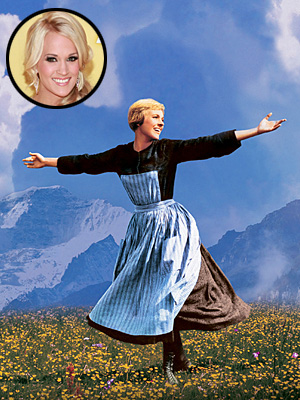
Poor Carrie Underwood received a drubbing from many critics for her performance in the TV revival of The Sound of Music (first aired on NBC on December 5, 2013.)  One of the kinder critics said her acting was like sleepwalking; others bordered on the vicious.  Most acknowledged that although she sang well, she acted poorly.  Ms. Underwood, understandably distressed by the negative criticism, tweeted: "Plain and simple: mean people need Jesus.  They will be in my prayers tonight: Peter 2 1-25."  Although my body lives a few hundred miles north of the Bible Belt and my mind lives many light-years beyond it, I get her point.  Her distress made me recall (I admit I don't need much stimulus to recall it, it's a great poem) the words of Theodore Roethke, which I quote here:

Behold the critic, pitched like the castrati,
imperious youngling, though approaching forty;
He heaps few honors on a living head,
He loves himself, and the illustrious dead;
He pipes, he squeaks, he quivers through his nose,--
Some cannot praise him; I am one of those.

I am generally one of those, too.  Non-artists have  little appreciation for the herculean effort and talent it takes to, say, adequately perform a group of Bach's Preludes and Fugues from memory or to pull off  a role as demanding as Maria in The Sound of Music.. Harold Bloom wrote in his "Anxiety of Influence" that serious authors are in competition with the likes of Shakespeare, a fact responsible for burning the midnight oil while brimming with midnight sweat.   Competing with Julie Andrews is not like competing with Shakespeare, but it is an awesome challenge nevertheless.

Critisicsm does have its place, however.  We do need critics to provide alembics to refine our taste; it's purpose is not to put anyone down, but to help lift our spirits up..  Critics need to be gentler, kinder, and be severe critics of egotism in themselves before they write a word.  They need to be humble, too; criticism is almost always on a lower level  than that of a performance. It certainly is in my case!


2.

YouTube used properly is great!  One can compare many interpretations of a single piece and gain a deeper understanding of what makes a performance mediocre or great.  As an avid amateur musician, I've had a lot of rewarding experiences doing just that.  Although I do indeed have favorite genres, I enjoy all types of music, popular to classical.  So, having had some experience as a YouTube critic, I decided to listen to Ms. Underwood's peformance and comment on it.  I did not hear the live performance; I only read some of the reviews.  Tonight, December 14, 2013, it s being shown again, a few hours from now. .A day or so after that, I will post this essay, along with my criticism of her performance.  There is no question of any allegiances on my part: I had never heard of Carrie Underwood before reading all the brouhaha from the critics.  I readily confess, however, that country music is not among my favorite musical genres.


3.

I can't help but write a few words regarding Richard Rodgers and Oscar Hammerstein.  Rodgers once said he could create a melody  as easily as he could tie his shoes; his extraordinary output attests to the fact that this was not a Muenchausen exaggeration.  His best songs transcend the musicals they first appeared in: My Favorite Things, for instance, has long since become a jazz standard.  His most poignant songs, among which are Hello, Young Lovers, You'll Never Walk Alone and Climb Ev'ry Mountain, are almost as beautiful as the best songs by Gershwin, and that says a lot.  I love the strange chord changes he sometimes used, say, on the "Every" of Climb Every Mountain and or on the "cold and it's damp" from The Lady is A Tramp.  And those simple, yet very effective bridges--that is, the B part of a song written in ABA form--they are wonderful.  Hammerstein was a great genius, too--examples abound.  Old Man River, for instance, is nothing short of amazing in regard to its symbolism and to its use of language.  Hammerstein always found the mots justes, for example: "Tote that barge, lift that bail, get a little drunk/and you land in jail."  Perfection! Rodgers and Hammerstein, in fact, began the tradition of the 'book musical" in which the plot was also very important.  Who would want to live for long periods without them?  

Having said that, I also believe that many of the musicals they wrote are somewhat dated.  They are sometimes just too sweet.  But only sometimes: Oklahoma! their first collaboration, perhaps deserved to be lampooned by Mel Brooks in The History of the World, Part 1, but let's not forget it contains some extraordinary music and a truly riveting portrait of a man suffering from mental illness, (Judd's monologue.) I also find some of the content of at least one of the musicals not only dated, but disturbing.  Am I the only one who considers swaths of The King and I to be racist?  I hope not.  In summary, all their musicals seem, to me at least, to fall a bit short of the perfection of My Fair Lady.  Don't get me wrong, though, falling a bit short of perfection is very high praise indeed.

I finished this section at 7:59 P.M., one minute before the telecast begins.  This essay will continue to be written at 11:01, P.M., a minute after the telecast is over.


4.

11:01 P.M.  Here is my criticism: Carrie Underwood looked beautiful.  She sang well.  He acting stank to high heaven.


5.

That little criticism came from the critic in Roethke's poem, the one who apparently needs Jesus, and you know what we think of him.  My assessment follows.

Thomas Dorsett, where the hell have you been?  The Sound of Music is a masterwork.  Wonderful music, wonderful words and a wonderful story.  The sheer genius of it!

I have to admit, though, that  Carrie Underwood did not act her part well.  This is especially problematic since Maria is supposed to be a bit of a  firebrand; "How do you hold a  moonbeam in your hand?"  She came across more like a pancake.  Her acting reminded one of a young lady trying her very best in a high school play--Not to worry, parents, she still has the makings of a good lawyer. I even heard some uptalking! It was really unfair to cast  her in a role she wasn't ready for, especially since  the rest of the cast was superb.  For instance, the abbess gave an outstanding performance of Climb Every Mountain, and the Captain not only acted very well, but sang even better.  One had the impression that all of the cast--even the children--had lots of acting experience behind them.  This combined with natural talent made the contrast with Ms. Underwood's underacting all the more striking.  It is unfair to compare the performance of someone who is not a natural actor and who apparently had had little  prior experience as an actor with those of seasoned top-notch performers.  I have to blame the executives behind the production for casting her as Maria.  They knew that Ms. Underwood is enormously popular and would attract many additional viewers.  And they were right: eighteen million viewers! (They're planning another TV revival, of course.)
I'm sure the rest of the cast was aware of Ms. Undersood's inability to act; I imagine that the executives overrode their concerns.  They saw big bucks in the making, and that's what they got.

I wish Ms. Underwood had found a mentor who told her the truth: she is a gifted singer, but would have to devote some serious time to learning the art of acting before attempting a role as challenging as Maria.  You were not ready for this part, but with a lot of effort, one day you might be. You're already halfway there--your singing was good.

How do you keep a wave upon the sand?  How do you keep a moonbeam in your hand?  There was a huge discrepancy between those words that refer to Maria and your performance. I leave you with a wonderful line of Whitman's: "Vivas for those who have failed!"  You deserve much praise for your efforts.

I have the feeling, though, that your career is far from over.  I wish you the best.


Wednesday, September 18, 2013

THE MUSIC OF MINDFULNESS

l.
One of the funniest--and profound--comedy skits I've seen recently was one of David Chappelle's, a very talented man.  He played the part of a blind African-American Ku Klux Klan leader.  The joke was, of course, that he had no idea he was black; recognizing talent when they don't see one, his fellow Klaners considered his rants sufficiently disgusting as to be downright inspirational.  (They had no idea he was black either, since he always dressed in the racist version of the burkha, that is, a white robe and a white hood which covered his entire head except for his eyes.)  At a heated point in one of his hate speeches, he attempted to cool off by removing his hood.  No more cheers from his audience-- just a barely audible gasp of shock.  You're black, they told him.  He refused to believe it.
I have never seen a more hilarious demonstration of an obvious fact: race is a social construct. Racial identity does not exist "out there" but in the mind. Racism involves characterizing another as "other"  or "foreign" based on superficialities, such as skin color and  other aspects of appearance. It is obviously still causing much harm around the world.  It is one of many examples of what I call the "staccato mind," which, along with "the legato mind" is the subject of this essay. Using an analogy from music, I will advocate for  the practice of legato thinking as a way to combat racism and other forms of harmful behavior.

2.

I don't remember what the two of us were discussing; I don't even remember who the other one was, except that he was white and about my age at the time.  (The time was approximately thirty years ago.)  I might have told him that while individual variations in a race demonstrate a broad spectrum of ability, there is no such range of ability when one race is compared to another; that is, one race is just as talented as another. (Racial division in evolution came late; no race has an edge regarding brain development over another.) Whatever I said, he didn't believe.  What about blacks? he asked.  They're only good in sports and music.
The racism of this statement is too obvious to deserve comment.   Instead,  I would like to address  the cultural obtuseness of what he said.
Achievement in sports is like any other achievement, that is, something truly remarkable.  (People like me who are much better at writing than at boxing are, nevertheless, pleased to take a few jabs occasionally--in writing--at snobs who consider athletic achievements to be unimportant. ) I must admit, however, that I spend much more time exercising than I do at watching sports.  My admiration for those who excel at competitive sports is like my attitude toward brain surgeons--respect without any attempt at emulation.
My attitude towards music is much different.  I am an avid amateur musician and have some expertise in this field.  (Thirty years ago I had no expertise; only a love for music, which has only intensified with the passage of time.)  I will now discuss that racial put-down from  a musical angle.
For me--and for many others--music at its best pierces one to the quick.  It is the universal "language"--the music of Michael Jackson--not to mention Mozart's--is able to be understood by people in Singapore, Senegal and Cincinnati.  The only adequate response to music at its best is utter astonishment, absolute awe.
Saying blacks are only good at music is like saying Shakespeare was only good at poetry and drama. That forgotten man with whom I spoke was not only prejudiced against a race, but ignorant of what are among that race's and all races' most stellar achievements. Music--like all art--must first of all entertain, but the best music does a lot more than entertain.  Music takes us into a divinely human realm where all who enter must, at least temporarily, leave the rags of greed, hate and delusion at the entrance.  When the nightingale is finished singing, we might recall Keats's words: "Fled is that music--/ Do I wake or sleep?"  If she had been singing a great work by Bach, music at its best challenges us, in the best sense of the verb, to wake up.

3.

Before I discuss the two basic attitudes towards others, which I call the staccoto and the legato mind, I will first define these musical terms.  Staccato means "detached" in Italian; it is a form of musical articulation in which the note in question is played for a shorter duration than one would expect, followed by silence. It is therefore always detached from the subsequent note.  There is no communication between them. The opposite is legato, Italian for "tied down."  In legato playing, one note is seamlessly connected to the following note, that is, with no silence in between.  Staccato technique in piano entails lifting the finger completely off the key before playing the next note.  In legato playing, the finger of the first note is released while the finger of the subsequent note is being pressed down, resulting in the sound of the first note flowing into the sound of the second without any interval.  That might sound easy, but it's not.  There is nothing that separates the amateur from the professional more than poor legato technique. (Legato playing necessitates frequent digital acrobatics, especially when notes of a melody are "voiced," that is played simultaneously with less important notes.) Practicing legato in the mind, as it were, is not easy either, and, as we shall see, the lack thereof causes many problems.

Let us now illustrate the legato and the staccato mind with four examples:

I read about the so-called 2 million biker gathering in Washington D.C. to commemorate the victims of 9/11.  I also read that it was organized to counter a so-called Million Muslim March on the same date at the same place.  The organizer of the bikers stated that their philosophy was "to stand by the Constitution, and Bill of Rights," adding that they're "against any fundamental transformation of America." This statement seems to contain code words for something else; I began to be suspicious. I noticed on the news that several bikers were holding anti-Muslim placards.  Many bikers came to Washington on 9/11/2013; the Million Muslim March renamed MiIllion American March Against Fear in order to sound less threatening, attracted very few participants.  It was not backed by most American Islamic groups.  Although the theme was tolerance, it was thought to be too risky to have a march of Muslims on the 9/11 twelve years after the terrorist attacks.

2.   A political Internet site lamented the death of a white man, murdered by a black man in Washington Square, New York City.  The black man, 31 years old, stated that he hated whites and would punch the next white man who came along.  The victim was a harmless 62 year old white man, who died from his injuries the next day. The authors contended that this case went underreported due to an anti-white bias in what they viewed as the liberal-controlled media.  The right-wing site was incensed that this "lamestream media" is not interested in reporting black-on white crime, just the other way around.  The authors lamented that no T shirts will be made to commemorate the white victim, an obvious reference to the death of Trayvon Martin.  Needless to say, the two enraged authors were both white.

3.  A young woman, studying to be a nurse, also worked as a waitress at a restaurant.  One day she noticed that one of the members of the party she had just served wrote on the credit card receipt, "No tip, N*****r!"  She showed it to her boss and it was reported.  The young lady, who looked perfectly decent, was subsequently interviewed.  I do not recall her exact words, but, as best as I can recall, she said: "Why would somebody write a thing like that?  I try to serve everybody well, and had no complaints while I served those who left me that receipt..  I love everyone.  I even love those who did this, although I do not love what they did."

4.  A young white man in uniform went into a deli.  He ordered a sandwich.  A teen on line behind him told him that the deli was owned by Muslims--how could he frequent a place like this?  The man behind the counter was dressed in Muslim attire and sported a full beard.  The teen went on and on.  A funny thing happened when the teen asked him, "Aren't you fighting these guys?" The soldier responded, without a trace of humor:  "No, not at the moment.  At the moment I'm just trying to order a sandwich."  He went on to state, justifiably angered, that he was wearing his uniform to defend, among other things, freedom of religion.  He didn't care if the man was a Muslim or not.  We're all Americans, he stated.  It turned out, as I suspected, that the whole thing had been staged, but the man in uniform obviously hadn't been acting. He was completely surprised when he was informed that everyone but him was following a script.  When he was asked whether he thought that his kindness made him a hero, he said no. All Americans must behave in this way, he replied.

The first two examples are examples of the staccato mind; the second two illustrate thinking with legato.  In those using a social staccato, the "note"  can be an individual or a group to which the individual belongs. .  It is "played" in a fashion completely disconnected from the next note, which can also be an individual or a group.  In the first example, bikers with an anti-Muslim bias ( I do not wish to imply that the majority of bikers had this bias) were playing the notes "us, us, us" in staccato fashion, separated from the notes--in this case, Muslims, that followed.  In the second example, the white authors were playing white notes completely separated from the notes sounded on black keys.  The authors obviously felt that the "lamestream media" were not interested in reporting examples of white victimization, which for them was a significant phenomenon.  This is a glaring example of the staccato mind.  What is really underreported is the appallingly high murder rate in the United States, which is six times higher than the rate in Germany.  When a black victim is involved, it is a black-on-black crime 94% of the time; when a white victim is involved, it involves a white-on-white crime 89% of the time.  The staccato white authors were apparently much more interested in portraying what they saw as widespread anti-white bias in the media then in reporting a tragic incident.   This disconnect makes it much easier to view others as enemies or opponents.
In the third example, a young woman is playing legato with her mind..  She even feels connected to those who have treated her in a cruel, staccato fashion. In the music playing in her mind, the individual notes are connected, resulting in beautiful melodies.  Legato thinking is just as evident in the fourth example, in which the serviceman includes all Americans as notes in a great American symphony.

Just as a pianist must spend a lot of time perfecting legato, I am suggesting that we attempt to master sounding  life in legato fashion..  This  practice of connection is a variation on Buddhist techniques of mindfulness.  It also recalls the Christian teaching that we see Christ in everyone, no exceptions.  Perhaps one could begin by practicing a form of legato meditation for fifteen minutes or so a day; during this practice one would  train oneself to "hear" the connection in relation to every individual they see, especially individuals of a different race or who have markedly different views.   One might begin with one's own family, connecting more harmonious members to more difficult members with the legato thoughts, such as "Deep down, she is as good as anyone else." "The pearl inside him is also the pearl inside me.  I can see it through the mud. " etc. Then one could expand practicing legato in relation to neighbors, with a deliberate effort to treat friendly and less friendly ones exactly the same, etc. A good challenge would be listening to political commentators who espouse a view very different from your own while practicing a feeling of connection to them as individuals, as fellow human beings.
I would encourage those interested in this practice to invent ways to do it on their own.  This is especially easy for those who are familiar with Buddhist meditation techniques.  I will give one I use as an example.  I exercise frequently, often at a facility where there are many treadmill machines.  I select one at the back, so the people in front won't notice if I stare at them.  I begin with the person on the treadmill farthest away from me on the left.  I look at this person while reciting these words in my mind:

                                   May you be happy, content and peaceful;                                
                                   May no harm come to you, may no trouble come 
                                   to you,                                
                                   May you always meet with success.
                                   May you meet and overcome
                                   Inevitable problems, difficulties and failures
                                   of life.

Then I proceed to the person on the neighboring treadmill, etc. I repeat the cycle until my exercise session is over. This meditation never fails to improve my spirits.  The primary purpose of meditation like this is not to feel good, however, but to help insure that good feelings get transformed into good actions. If we master legato thinking for fifteen minutes or so a day for a while, we can then proceed to increasing the amount of time.  Thinking in legato fashion is like walking a mile in your's neighbor's moccasins before judging him or her.  The resultant harmony is undoubtedly worth hours and hours of practice.
In music legato playing is crucial, but there is a place for staccato too.  This is also true in life.  If we never separated ourselves temporarily  from others, we would never be able to fashion ourselves into instruments which are capable of playing legato in a beautiful way.  We must think, we must learn, we must plan; such essential activities demand time spent in solitude..  The purpose of this separation, however, is to increase our abilities to connect.  Wisdom and love are undoubtedly what's most important in life; by the practice of legato thinking--even when it hurts, it's not easy-- we become wiser and more loving.  And you don't need a piano--that wonderful instrument, yourself, is with you at all times.
Keats wrote that heard music is sweet, but unheard melodies are sweeter.  The more we practice legato thinking, the more audible the great music we are becomes.  If we keep on practicing, we will eventually be able to hear the sweetest music of all, Silence. If we practice the music of mindfulness, the world will become a better place, and we will be astonished by what we "hear." Why not begin with a fifteen minute session of legato meditation today?  Sooner or later, we'll all be glad you did.


A related article: Legato and Narcissism by Thomas Dorsett, can be accessed on the internet by googling the title and author together.