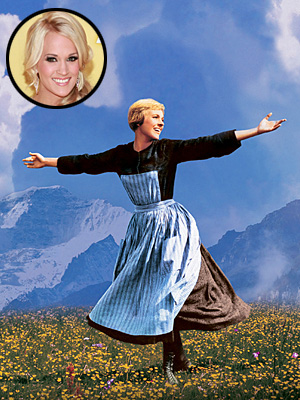
Poor Carrie Underwood received a drubbing from many critics for her performance in the TV revival of The Sound of Music (first aired on NBC on December 5, 2013.) One of the kinder critics said her acting was like sleepwalking; others bordered on the vicious. Most acknowledged that although she sang well, she acted poorly. Ms. Underwood, understandably distressed by the negative criticism, tweeted: "Plain and simple: mean people need Jesus. They will be in my prayers tonight: Peter 2 1-25." Although my body lives a few hundred miles north of the Bible Belt and my mind lives many light-years beyond it, I get her point. Her distress made me recall (I admit I don't need much stimulus to recall it, it's a great poem) the words of Theodore Roethke, which I quote here:
Behold the critic, pitched like the castrati,
imperious youngling, though approaching forty;
He heaps few honors on a living head,
He loves himself, and the illustrious dead;
He pipes, he squeaks, he quivers through his nose,--
Some cannot praise him; I am one of those.
I am generally one of those, too. Non-artists have little appreciation for the herculean effort and talent it takes to, say, adequately perform a group of Bach's Preludes and Fugues from memory or to pull off a role as demanding as Maria in The Sound of Music.. Harold Bloom wrote in his "Anxiety of Influence" that serious authors are in competition with the likes of Shakespeare, a fact responsible for burning the midnight oil while brimming with midnight sweat. Competing with Julie Andrews is not like competing with Shakespeare, but it is an awesome challenge nevertheless.
Critisicsm does have its place, however. We do need critics to provide alembics to refine our taste; it's purpose is not to put anyone down, but to help lift our spirits up.. Critics need to be gentler, kinder, and be severe critics of egotism in themselves before they write a word. They need to be humble, too; criticism is almost always on a lower level than that of a performance. It certainly is in my case!
2.
YouTube used properly is great! One can compare many interpretations of a single piece and gain a deeper understanding of what makes a performance mediocre or great. As an avid amateur musician, I've had a lot of rewarding experiences doing just that. Although I do indeed have favorite genres, I enjoy all types of music, popular to classical. So, having had some experience as a YouTube critic, I decided to listen to Ms. Underwood's peformance and comment on it. I did not hear the live performance; I only read some of the reviews. Tonight, December 14, 2013, it s being shown again, a few hours from now. .A day or so after that, I will post this essay, along with my criticism of her performance. There is no question of any allegiances on my part: I had never heard of Carrie Underwood before reading all the brouhaha from the critics. I readily confess, however, that country music is not among my favorite musical genres.
3.
I can't help but write a few words regarding Richard Rodgers and Oscar Hammerstein. Rodgers once said he could create a melody as easily as he could tie his shoes; his extraordinary output attests to the fact that this was not a Muenchausen exaggeration. His best songs transcend the musicals they first appeared in: My Favorite Things, for instance, has long since become a jazz standard. His most poignant songs, among which are Hello, Young Lovers, You'll Never Walk Alone and Climb Ev'ry Mountain, are almost as beautiful as the best songs by Gershwin, and that says a lot. I love the strange chord changes he sometimes used, say, on the "Every" of Climb Every Mountain and or on the "cold and it's damp" from The Lady is A Tramp. And those simple, yet very effective bridges--that is, the B part of a song written in ABA form--they are wonderful. Hammerstein was a great genius, too--examples abound. Old Man River, for instance, is nothing short of amazing in regard to its symbolism and to its use of language. Hammerstein always found the mots justes, for example: "Tote that barge, lift that bail, get a little drunk/and you land in jail." Perfection! Rodgers and Hammerstein, in fact, began the tradition of the 'book musical" in which the plot was also very important. Who would want to live for long periods without them?
Having said that, I also believe that many of the musicals they wrote are somewhat dated. They are sometimes just too sweet. But only sometimes: Oklahoma! their first collaboration, perhaps deserved to be lampooned by Mel Brooks in The History of the World, Part 1, but let's not forget it contains some extraordinary music and a truly riveting portrait of a man suffering from mental illness, (Judd's monologue.) I also find some of the content of at least one of the musicals not only dated, but disturbing. Am I the only one who considers swaths of The King and I to be racist? I hope not. In summary, all their musicals seem, to me at least, to fall a bit short of the perfection of My Fair Lady. Don't get me wrong, though, falling a bit short of perfection is very high praise indeed.
I finished this section at 7:59 P.M., one minute before the telecast begins. This essay will continue to be written at 11:01, P.M., a minute after the telecast is over.
4.
11:01 P.M. Here is my criticism: Carrie Underwood looked beautiful. She sang well. He acting stank to high heaven.
5.
That little criticism came from the critic in Roethke's poem, the one who apparently needs Jesus, and you know what we think of him. My assessment follows.
Thomas Dorsett, where the hell have you been? The Sound of Music is a masterwork. Wonderful music, wonderful words and a wonderful story. The sheer genius of it!
I have to admit, though, that Carrie Underwood did not act her part well. This is especially problematic since Maria is supposed to be a bit of a firebrand; "How do you hold a moonbeam in your hand?" She came across more like a pancake. Her acting reminded one of a young lady trying her very best in a high school play--Not to worry, parents, she still has the makings of a good lawyer. I even heard some uptalking! It was really unfair to cast her in a role she wasn't ready for, especially since the rest of the cast was superb. For instance, the abbess gave an outstanding performance of Climb Every Mountain, and the Captain not only acted very well, but sang even better. One had the impression that all of the cast--even the children--had lots of acting experience behind them. This combined with natural talent made the contrast with Ms. Underwood's underacting all the more striking. It is unfair to compare the performance of someone who is not a natural actor and who apparently had had little prior experience as an actor with those of seasoned top-notch performers. I have to blame the executives behind the production for casting her as Maria. They knew that Ms. Underwood is enormously popular and would attract many additional viewers. And they were right: eighteen million viewers! (They're planning another TV revival, of course.)
I'm sure the rest of the cast was aware of Ms. Undersood's inability to act; I imagine that the executives overrode their concerns. They saw big bucks in the making, and that's what they got.
I wish Ms. Underwood had found a mentor who told her the truth: she is a gifted singer, but would have to devote some serious time to learning the art of acting before attempting a role as challenging as Maria. You were not ready for this part, but with a lot of effort, one day you might be. You're already halfway there--your singing was good.
How do you keep a wave upon the sand? How do you keep a moonbeam in your hand? There was a huge discrepancy between those words that refer to Maria and your performance. I leave you with a wonderful line of Whitman's: "Vivas for those who have failed!" You deserve much praise for your efforts.
I have the feeling, though, that your career is far from over. I wish you the best.

No comments:
Post a Comment