Sunday, December 15, 2013

CAN CARRIE CARRY MORE THAN A TUNE?


1.

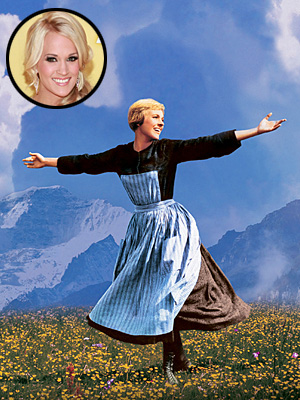
Poor Carrie Underwood received a drubbing from many critics for her performance in the TV revival of The Sound of Music (first aired on NBC on December 5, 2013.)  One of the kinder critics said her acting was like sleepwalking; others bordered on the vicious.  Most acknowledged that although she sang well, she acted poorly.  Ms. Underwood, understandably distressed by the negative criticism, tweeted: "Plain and simple: mean people need Jesus.  They will be in my prayers tonight: Peter 2 1-25."  Although my body lives a few hundred miles north of the Bible Belt and my mind lives many light-years beyond it, I get her point.  Her distress made me recall (I admit I don't need much stimulus to recall it, it's a great poem) the words of Theodore Roethke, which I quote here:

Behold the critic, pitched like the castrati,
imperious youngling, though approaching forty;
He heaps few honors on a living head,
He loves himself, and the illustrious dead;
He pipes, he squeaks, he quivers through his nose,--
Some cannot praise him; I am one of those.

I am generally one of those, too.  Non-artists have  little appreciation for the herculean effort and talent it takes to, say, adequately perform a group of Bach's Preludes and Fugues from memory or to pull off  a role as demanding as Maria in The Sound of Music.. Harold Bloom wrote in his "Anxiety of Influence" that serious authors are in competition with the likes of Shakespeare, a fact responsible for burning the midnight oil while brimming with midnight sweat.   Competing with Julie Andrews is not like competing with Shakespeare, but it is an awesome challenge nevertheless.

Critisicsm does have its place, however.  We do need critics to provide alembics to refine our taste; it's purpose is not to put anyone down, but to help lift our spirits up..  Critics need to be gentler, kinder, and be severe critics of egotism in themselves before they write a word.  They need to be humble, too; criticism is almost always on a lower level  than that of a performance. It certainly is in my case!


2.

YouTube used properly is great!  One can compare many interpretations of a single piece and gain a deeper understanding of what makes a performance mediocre or great.  As an avid amateur musician, I've had a lot of rewarding experiences doing just that.  Although I do indeed have favorite genres, I enjoy all types of music, popular to classical.  So, having had some experience as a YouTube critic, I decided to listen to Ms. Underwood's peformance and comment on it.  I did not hear the live performance; I only read some of the reviews.  Tonight, December 14, 2013, it s being shown again, a few hours from now. .A day or so after that, I will post this essay, along with my criticism of her performance.  There is no question of any allegiances on my part: I had never heard of Carrie Underwood before reading all the brouhaha from the critics.  I readily confess, however, that country music is not among my favorite musical genres.


3.

I can't help but write a few words regarding Richard Rodgers and Oscar Hammerstein.  Rodgers once said he could create a melody  as easily as he could tie his shoes; his extraordinary output attests to the fact that this was not a Muenchausen exaggeration.  His best songs transcend the musicals they first appeared in: My Favorite Things, for instance, has long since become a jazz standard.  His most poignant songs, among which are Hello, Young Lovers, You'll Never Walk Alone and Climb Ev'ry Mountain, are almost as beautiful as the best songs by Gershwin, and that says a lot.  I love the strange chord changes he sometimes used, say, on the "Every" of Climb Every Mountain and or on the "cold and it's damp" from The Lady is A Tramp.  And those simple, yet very effective bridges--that is, the B part of a song written in ABA form--they are wonderful.  Hammerstein was a great genius, too--examples abound.  Old Man River, for instance, is nothing short of amazing in regard to its symbolism and to its use of language.  Hammerstein always found the mots justes, for example: "Tote that barge, lift that bail, get a little drunk/and you land in jail."  Perfection! Rodgers and Hammerstein, in fact, began the tradition of the 'book musical" in which the plot was also very important.  Who would want to live for long periods without them?  

Having said that, I also believe that many of the musicals they wrote are somewhat dated.  They are sometimes just too sweet.  But only sometimes: Oklahoma! their first collaboration, perhaps deserved to be lampooned by Mel Brooks in The History of the World, Part 1, but let's not forget it contains some extraordinary music and a truly riveting portrait of a man suffering from mental illness, (Judd's monologue.) I also find some of the content of at least one of the musicals not only dated, but disturbing.  Am I the only one who considers swaths of The King and I to be racist?  I hope not.  In summary, all their musicals seem, to me at least, to fall a bit short of the perfection of My Fair Lady.  Don't get me wrong, though, falling a bit short of perfection is very high praise indeed.

I finished this section at 7:59 P.M., one minute before the telecast begins.  This essay will continue to be written at 11:01, P.M., a minute after the telecast is over.


4.

11:01 P.M.  Here is my criticism: Carrie Underwood looked beautiful.  She sang well.  He acting stank to high heaven.


5.

That little criticism came from the critic in Roethke's poem, the one who apparently needs Jesus, and you know what we think of him.  My assessment follows.

Thomas Dorsett, where the hell have you been?  The Sound of Music is a masterwork.  Wonderful music, wonderful words and a wonderful story.  The sheer genius of it!

I have to admit, though, that  Carrie Underwood did not act her part well.  This is especially problematic since Maria is supposed to be a bit of a  firebrand; "How do you hold a  moonbeam in your hand?"  She came across more like a pancake.  Her acting reminded one of a young lady trying her very best in a high school play--Not to worry, parents, she still has the makings of a good lawyer. I even heard some uptalking! It was really unfair to cast  her in a role she wasn't ready for, especially since  the rest of the cast was superb.  For instance, the abbess gave an outstanding performance of Climb Every Mountain, and the Captain not only acted very well, but sang even better.  One had the impression that all of the cast--even the children--had lots of acting experience behind them.  This combined with natural talent made the contrast with Ms. Underwood's underacting all the more striking.  It is unfair to compare the performance of someone who is not a natural actor and who apparently had had little  prior experience as an actor with those of seasoned top-notch performers.  I have to blame the executives behind the production for casting her as Maria.  They knew that Ms. Underwood is enormously popular and would attract many additional viewers.  And they were right: eighteen million viewers! (They're planning another TV revival, of course.)
I'm sure the rest of the cast was aware of Ms. Undersood's inability to act; I imagine that the executives overrode their concerns.  They saw big bucks in the making, and that's what they got.

I wish Ms. Underwood had found a mentor who told her the truth: she is a gifted singer, but would have to devote some serious time to learning the art of acting before attempting a role as challenging as Maria.  You were not ready for this part, but with a lot of effort, one day you might be. You're already halfway there--your singing was good.

How do you keep a wave upon the sand?  How do you keep a moonbeam in your hand?  There was a huge discrepancy between those words that refer to Maria and your performance. I leave you with a wonderful line of Whitman's: "Vivas for those who have failed!"  You deserve much praise for your efforts.

I have the feeling, though, that your career is far from over.  I wish you the best.


Wednesday, September 18, 2013

THE MUSIC OF MINDFULNESS

l.
One of the funniest--and profound--comedy skits I've seen recently was one of David Chappelle's, a very talented man.  He played the part of a blind African-American Ku Klux Klan leader.  The joke was, of course, that he had no idea he was black; recognizing talent when they don't see one, his fellow Klaners considered his rants sufficiently disgusting as to be downright inspirational.  (They had no idea he was black either, since he always dressed in the racist version of the burkha, that is, a white robe and a white hood which covered his entire head except for his eyes.)  At a heated point in one of his hate speeches, he attempted to cool off by removing his hood.  No more cheers from his audience-- just a barely audible gasp of shock.  You're black, they told him.  He refused to believe it.
I have never seen a more hilarious demonstration of an obvious fact: race is a social construct. Racial identity does not exist "out there" but in the mind. Racism involves characterizing another as "other"  or "foreign" based on superficialities, such as skin color and  other aspects of appearance. It is obviously still causing much harm around the world.  It is one of many examples of what I call the "staccato mind," which, along with "the legato mind" is the subject of this essay. Using an analogy from music, I will advocate for  the practice of legato thinking as a way to combat racism and other forms of harmful behavior.

2.

I don't remember what the two of us were discussing; I don't even remember who the other one was, except that he was white and about my age at the time.  (The time was approximately thirty years ago.)  I might have told him that while individual variations in a race demonstrate a broad spectrum of ability, there is no such range of ability when one race is compared to another; that is, one race is just as talented as another. (Racial division in evolution came late; no race has an edge regarding brain development over another.) Whatever I said, he didn't believe.  What about blacks? he asked.  They're only good in sports and music.
The racism of this statement is too obvious to deserve comment.   Instead,  I would like to address  the cultural obtuseness of what he said.
Achievement in sports is like any other achievement, that is, something truly remarkable.  (People like me who are much better at writing than at boxing are, nevertheless, pleased to take a few jabs occasionally--in writing--at snobs who consider athletic achievements to be unimportant. ) I must admit, however, that I spend much more time exercising than I do at watching sports.  My admiration for those who excel at competitive sports is like my attitude toward brain surgeons--respect without any attempt at emulation.
My attitude towards music is much different.  I am an avid amateur musician and have some expertise in this field.  (Thirty years ago I had no expertise; only a love for music, which has only intensified with the passage of time.)  I will now discuss that racial put-down from  a musical angle.
For me--and for many others--music at its best pierces one to the quick.  It is the universal "language"--the music of Michael Jackson--not to mention Mozart's--is able to be understood by people in Singapore, Senegal and Cincinnati.  The only adequate response to music at its best is utter astonishment, absolute awe.
Saying blacks are only good at music is like saying Shakespeare was only good at poetry and drama. That forgotten man with whom I spoke was not only prejudiced against a race, but ignorant of what are among that race's and all races' most stellar achievements. Music--like all art--must first of all entertain, but the best music does a lot more than entertain.  Music takes us into a divinely human realm where all who enter must, at least temporarily, leave the rags of greed, hate and delusion at the entrance.  When the nightingale is finished singing, we might recall Keats's words: "Fled is that music--/ Do I wake or sleep?"  If she had been singing a great work by Bach, music at its best challenges us, in the best sense of the verb, to wake up.

3.

Before I discuss the two basic attitudes towards others, which I call the staccoto and the legato mind, I will first define these musical terms.  Staccato means "detached" in Italian; it is a form of musical articulation in which the note in question is played for a shorter duration than one would expect, followed by silence. It is therefore always detached from the subsequent note.  There is no communication between them. The opposite is legato, Italian for "tied down."  In legato playing, one note is seamlessly connected to the following note, that is, with no silence in between.  Staccato technique in piano entails lifting the finger completely off the key before playing the next note.  In legato playing, the finger of the first note is released while the finger of the subsequent note is being pressed down, resulting in the sound of the first note flowing into the sound of the second without any interval.  That might sound easy, but it's not.  There is nothing that separates the amateur from the professional more than poor legato technique. (Legato playing necessitates frequent digital acrobatics, especially when notes of a melody are "voiced," that is played simultaneously with less important notes.) Practicing legato in the mind, as it were, is not easy either, and, as we shall see, the lack thereof causes many problems.

Let us now illustrate the legato and the staccato mind with four examples:

I read about the so-called 2 million biker gathering in Washington D.C. to commemorate the victims of 9/11.  I also read that it was organized to counter a so-called Million Muslim March on the same date at the same place.  The organizer of the bikers stated that their philosophy was "to stand by the Constitution, and Bill of Rights," adding that they're "against any fundamental transformation of America." This statement seems to contain code words for something else; I began to be suspicious. I noticed on the news that several bikers were holding anti-Muslim placards.  Many bikers came to Washington on 9/11/2013; the Million Muslim March renamed MiIllion American March Against Fear in order to sound less threatening, attracted very few participants.  It was not backed by most American Islamic groups.  Although the theme was tolerance, it was thought to be too risky to have a march of Muslims on the 9/11 twelve years after the terrorist attacks.

2.   A political Internet site lamented the death of a white man, murdered by a black man in Washington Square, New York City.  The black man, 31 years old, stated that he hated whites and would punch the next white man who came along.  The victim was a harmless 62 year old white man, who died from his injuries the next day. The authors contended that this case went underreported due to an anti-white bias in what they viewed as the liberal-controlled media.  The right-wing site was incensed that this "lamestream media" is not interested in reporting black-on white crime, just the other way around.  The authors lamented that no T shirts will be made to commemorate the white victim, an obvious reference to the death of Trayvon Martin.  Needless to say, the two enraged authors were both white.

3.  A young woman, studying to be a nurse, also worked as a waitress at a restaurant.  One day she noticed that one of the members of the party she had just served wrote on the credit card receipt, "No tip, N*****r!"  She showed it to her boss and it was reported.  The young lady, who looked perfectly decent, was subsequently interviewed.  I do not recall her exact words, but, as best as I can recall, she said: "Why would somebody write a thing like that?  I try to serve everybody well, and had no complaints while I served those who left me that receipt..  I love everyone.  I even love those who did this, although I do not love what they did."

4.  A young white man in uniform went into a deli.  He ordered a sandwich.  A teen on line behind him told him that the deli was owned by Muslims--how could he frequent a place like this?  The man behind the counter was dressed in Muslim attire and sported a full beard.  The teen went on and on.  A funny thing happened when the teen asked him, "Aren't you fighting these guys?" The soldier responded, without a trace of humor:  "No, not at the moment.  At the moment I'm just trying to order a sandwich."  He went on to state, justifiably angered, that he was wearing his uniform to defend, among other things, freedom of religion.  He didn't care if the man was a Muslim or not.  We're all Americans, he stated.  It turned out, as I suspected, that the whole thing had been staged, but the man in uniform obviously hadn't been acting. He was completely surprised when he was informed that everyone but him was following a script.  When he was asked whether he thought that his kindness made him a hero, he said no. All Americans must behave in this way, he replied.

The first two examples are examples of the staccato mind; the second two illustrate thinking with legato.  In those using a social staccato, the "note"  can be an individual or a group to which the individual belongs. .  It is "played" in a fashion completely disconnected from the next note, which can also be an individual or a group.  In the first example, bikers with an anti-Muslim bias ( I do not wish to imply that the majority of bikers had this bias) were playing the notes "us, us, us" in staccato fashion, separated from the notes--in this case, Muslims, that followed.  In the second example, the white authors were playing white notes completely separated from the notes sounded on black keys.  The authors obviously felt that the "lamestream media" were not interested in reporting examples of white victimization, which for them was a significant phenomenon.  This is a glaring example of the staccato mind.  What is really underreported is the appallingly high murder rate in the United States, which is six times higher than the rate in Germany.  When a black victim is involved, it is a black-on-black crime 94% of the time; when a white victim is involved, it involves a white-on-white crime 89% of the time.  The staccato white authors were apparently much more interested in portraying what they saw as widespread anti-white bias in the media then in reporting a tragic incident.   This disconnect makes it much easier to view others as enemies or opponents.
In the third example, a young woman is playing legato with her mind..  She even feels connected to those who have treated her in a cruel, staccato fashion. In the music playing in her mind, the individual notes are connected, resulting in beautiful melodies.  Legato thinking is just as evident in the fourth example, in which the serviceman includes all Americans as notes in a great American symphony.

Just as a pianist must spend a lot of time perfecting legato, I am suggesting that we attempt to master sounding  life in legato fashion..  This  practice of connection is a variation on Buddhist techniques of mindfulness.  It also recalls the Christian teaching that we see Christ in everyone, no exceptions.  Perhaps one could begin by practicing a form of legato meditation for fifteen minutes or so a day; during this practice one would  train oneself to "hear" the connection in relation to every individual they see, especially individuals of a different race or who have markedly different views.   One might begin with one's own family, connecting more harmonious members to more difficult members with the legato thoughts, such as "Deep down, she is as good as anyone else." "The pearl inside him is also the pearl inside me.  I can see it through the mud. " etc. Then one could expand practicing legato in relation to neighbors, with a deliberate effort to treat friendly and less friendly ones exactly the same, etc. A good challenge would be listening to political commentators who espouse a view very different from your own while practicing a feeling of connection to them as individuals, as fellow human beings.
I would encourage those interested in this practice to invent ways to do it on their own.  This is especially easy for those who are familiar with Buddhist meditation techniques.  I will give one I use as an example.  I exercise frequently, often at a facility where there are many treadmill machines.  I select one at the back, so the people in front won't notice if I stare at them.  I begin with the person on the treadmill farthest away from me on the left.  I look at this person while reciting these words in my mind:

                                   May you be happy, content and peaceful;                                
                                   May no harm come to you, may no trouble come 
                                   to you,                                
                                   May you always meet with success.
                                   May you meet and overcome
                                   Inevitable problems, difficulties and failures
                                   of life.

Then I proceed to the person on the neighboring treadmill, etc. I repeat the cycle until my exercise session is over. This meditation never fails to improve my spirits.  The primary purpose of meditation like this is not to feel good, however, but to help insure that good feelings get transformed into good actions. If we master legato thinking for fifteen minutes or so a day for a while, we can then proceed to increasing the amount of time.  Thinking in legato fashion is like walking a mile in your's neighbor's moccasins before judging him or her.  The resultant harmony is undoubtedly worth hours and hours of practice.
In music legato playing is crucial, but there is a place for staccato too.  This is also true in life.  If we never separated ourselves temporarily  from others, we would never be able to fashion ourselves into instruments which are capable of playing legato in a beautiful way.  We must think, we must learn, we must plan; such essential activities demand time spent in solitude..  The purpose of this separation, however, is to increase our abilities to connect.  Wisdom and love are undoubtedly what's most important in life; by the practice of legato thinking--even when it hurts, it's not easy-- we become wiser and more loving.  And you don't need a piano--that wonderful instrument, yourself, is with you at all times.
Keats wrote that heard music is sweet, but unheard melodies are sweeter.  The more we practice legato thinking, the more audible the great music we are becomes.  If we keep on practicing, we will eventually be able to hear the sweetest music of all, Silence. If we practice the music of mindfulness, the world will become a better place, and we will be astonished by what we "hear." Why not begin with a fifteen minute session of legato meditation today?  Sooner or later, we'll all be glad you did.


A related article: Legato and Narcissism by Thomas Dorsett, can be accessed on the internet by googling the title and author together.


Tuesday, May 7, 2013

IT'S ABOUT TIME!

I am sixty-seven years old.  I have always felt that mine has been a rather difficult life--I will spare you the details--but I am beginning to feel otherwise, and will try to tell you why.  (It is good to depict overcome sorrow.)

If I had some finite difficulties, I made them almost infinitely worse by my desire to spectacularly triumph over them.  I expected the world to say, Ah!  Despite enormous dead weights on his chest, he has flicked them away as if they were peanuts; this guy's a winner--he's truly amazing!  That didn't happen. Unhailed, unheld, unheard, I came to a great river instead.  It is very deep.  It is very wide.  It is quite impassable.  I'm getting  over it, nevertheless.

What's getting into me?  I don't know.  I feel as if some sage is taking over, replacing me with Me.

                                                                   2.

Our health club recently closed; my wife and I soon found another one.  At this facility, we have attended several classes, including yoga classes.  The instructor was young, perky and very flexible.  After attending a few sessions, I was disappointed to hear that she was leaving.  She passed out her business cards to us, in case we'd like to contact her.  I noticed above her name another name in capital letters: SHAMS. What good would it do to tell you that this resulted in a great shock, as if a wave of electricity passed through my being?

I knew that Shams had been the teacher of Rumi.  All the wisdom that Rumi acquired--which was considerable--he attributed to Shams.  The silent imam who, after imparting this wisdom, mysteriously disappeared.

Yes, something inside me said, he is the one taking over.  What nonsense, Doubting Thomas replied.  Then how do you account for these changes?  What changes?  Tomorrow you'll be back to your old ways, and no one will ever notice anything.  Don't be so sure, don't be so sure.

All right, Doubting Thomas said.  Let's test this guy out.  If Shams is really visiting you after being God-Knows-Where for almost a thousand years, ask him to tell you something in Arabic or Persian in a dream.  You, as we well know, I told myself, don't know Arabic or Persian.  If you tell me something he says, and I look it up and finds out it means something, I just might begin to believe you.

That night I did see Shams in a dream.  He kept repeating "Fana, Fana, Fana."  I had no idea what that meant.  Until Doubting Thomas looked it up.

Fana is the Sufi term for dying to the self, thus giving birth to the Self.  If you think that the business card caused a shock, you can well imagine the shock this caused.

I am not letting you claim this as a miracle, Doubting Thomas told Me.

                                                           3.

I am sitting on a bench.  I am aware of an inner light.  It passes outside my body, while, paradoxically, still remaining within.  It is now a sun, which has risen above a beautiful river.  I am on a hill which descends to the bank of the river.  I must go down to it now.

My hands rise.  I realize that I'm sitting on no ordinary bench; it is my piano bench.  My hands begin to play something I've never played before: the spiritual, Down by The Riverside.   I play it calmly and slowly at first, then  pick up volume and speed.  My hands--as if they were Shams's--begin to play all sorts of variations, including some which contain harmonies I hadn't ever heard.  I am in ecstasy, tears of joy running down my face.

Ain't gonna study war no more, ain't going to study war no more.  This time I mean it!

Still playing, I looked up and saw a face.  If this were fiction, I would tell you that it was Shams's face.  But it wasn't.  It was the face of the great Indian sage, Ramana Maharshi, the avatar of advaita, non-duality, the teaching that everything is One.

Ain't gonna study war no more--Ramana Maharshi, this time I mean it!

I finished playing the spiritual.  The sage was smiling.  He didn't move his lips, but my inner being clearly heard him say, "It's about time!"